Description
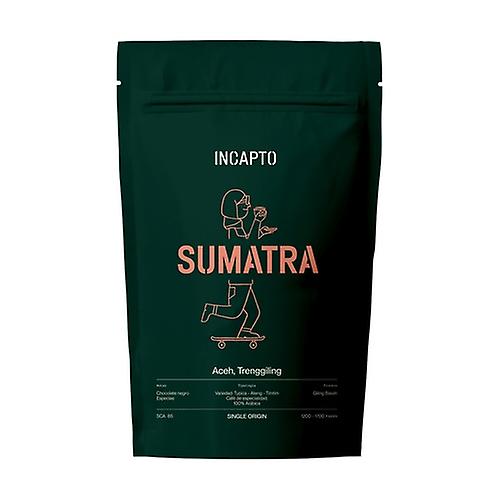
Sumatran Coffee Aceh Trenggiling 500 g
Sumatra is an island located in the extreme west of Indonesia, between the Indian Ocean and the Strait of Malacca. It is the 6th largest island in the world, and the largest island entirely in Indonesia (New Guinea and Borneo share borders with other countries). Ecuador crosses Sumatra in its center, for this reason the island's climate is tropical, very hot and extremely humid.
Aceh is a province of Sumatra. It is located in the extreme north of the island, and its capital is Banda Aceh. Its population has the highest number of Muslims in all of Indonesia. There are 10 indigenous ethnic groups living in the Aceh region. One of these groups is the Gaius, who almost entirely occupy the highest lands in the region (Aceg Tengah). This tribe today has a population of approx. 330,000 people.
The Dutch violently occupied this area between 1904 and 1942, after "winning" the "Aceh War" between 1873 and 1904. It was during this period that Gayonaes developed an economy based on the intercropping of fruits and / or vegetables with coffee. Today there are a large number of small coffee growers in the Aceh Tengah area, whose farms have an average size of half a hectare, for this reason they must be grouped and organized into groups of coffee growers and cooperatives.
The history of coffee in Indonesia , like in many other producing countries of the world, begins with stories of colonialism, slavery, monopoly and multinational corporations (Yes
The first in modern history are founded in the early seventeenth century).
In 1602, the Dutch government established the “Dutch East India Company” (VOC, Verenigde Oost-indische Compagnie) as a chartered company (association formed by investors and shareholders for the purpose of trade, exploration and colonization) and le granted a 21-year monopoly on the Dutch spice trade. This was the first model of what we now consider a multinational corporation.
In 1616 the Dutch East Indies Company started the coffee trade in Mocha (Yemen) and during the first half of the 17th century they only traded coffee in the Arab world and in Asia, because there was no demand for coffee in Europe that moment.
At the end of the 17th century, cafes spread throughout Europe and the Dutch, English and French began to import coffee from different Arab ports. The Arabs had banned trade in coffee beans or fertile plants, of course, they wanted to maintain their monopoly. But when coffee became very popular in Europe around 1690, and political problems in Arab countries threatened coffee imports, several European countries attempted to obtain coffee plants or seeds for commercial purposes.
The race to get hold of some fertile coffee plants or seeds was eventually won by the Dutch. Who obtained the plants probably in Malabar (India), where at that time the Dutch East India Company ruled.
Coffee plants were introduced to Batavia (today Jakarta) Indonesia in 1696. In 1711 the first coffee exports were shipped from Java to Europe. The first shipment of coffee was 450 kg. And ten years later, the export had already reached 60,000 kg.
Originally coffee was grown only in Java, but in 1870, the Dutch expanded the coffee growing areas to Sumatra, Bali, Sulawesi, and Timor. In northern Sumatra, coffee was first cultivated near Lake Toba in 1888; and then in the Gaius Mountains, near Lake Tawar, around 1924.
COUNTRY: Sumatra (Indonesia)
FINCA: Atu Lintang, PT. Ihitiyeri Keti Ara
REGION: Gaius
ALTITUDE: Between 1,400 - 1,600 meters
PROCESS: Giling Basah
TYPOLOGY: Specialty
SCA: 87
VARIETY: Giling Basah Process
Coffee is a very delicate product. Upon contact with air it oxidizes and begins to lose its organoleptic properties; For this reason we give you some tips to keep it better:
- Open the bag by the easy opening of the zip / zipper. Never above. Once you have inserted the coffee beans into the compartment of the super automatic coffee bean machine, carefully close the zip again.
- Put the necessary amount of coffee for up to two days. The coffee keeps better in the bag with the zip closed than in the compartment or hopper of the coffee maker.
- In the case of not having our super-automatic coffee machines, grind the coffee that you are going to use. Once the coffee is ground, the oxidation process multiplies by fifteen. That means it will lose its flavor and aroma much faster.
- If you can, once you have opened the bag, store the coffee in a container with a hermetic seal or with a vacuum seal so that it has the minimum contact with air and minimizes the oxidation process. In our accessories section you will find products specially
-
Identifiant Fruugo:
50947159-101910985
-
EAN:
8436591720157